
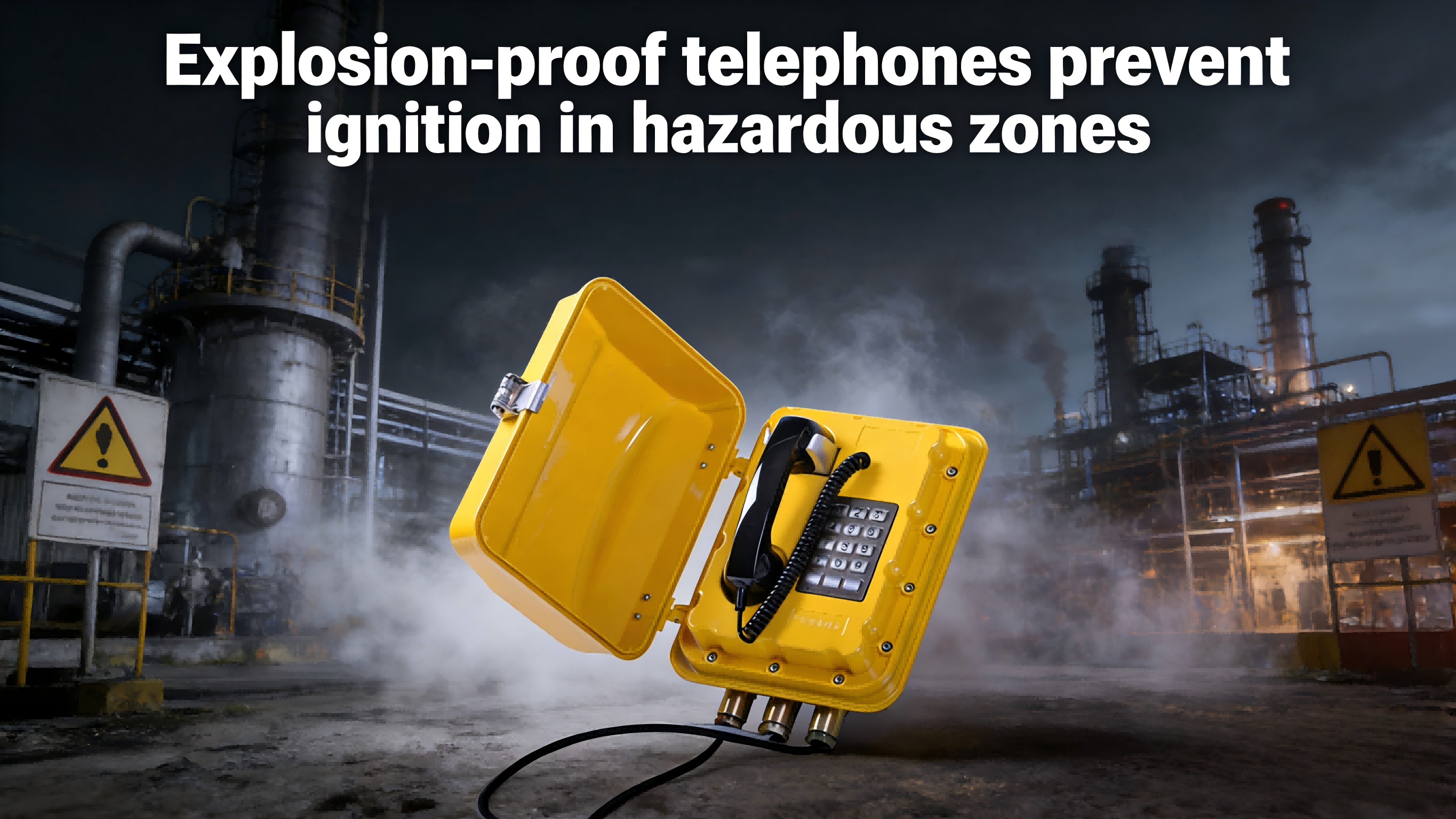
Explosion-proof telephones prevent ignition in hazardous zones. They contain internal sparks and heat within robust enclosures. These devices also limit electrical and thermal energy. This ensures safe communication in explosive atmospheres. The global market for explosion-proof mobile communication devices is growing. It will reach USD 1.07 billion by 2030, showing their critical importance.
Key Takeaways
- Explosion-proof telephones stop fires by keeping sparks inside strong cases or by using very little electricity.
- Certifications like ATEX and UL show that these phones are safe to use in places where gas or dust could explode.
- Regular checks and care for these phones are important to keep them working safely and prevent accidents.
Core Ignition Prevention Mechanisms of Explosion-Proof Telephone
Explosion-proof telephones use clever engineering to stop sparks from causing big problems. They focus on two main ways to prevent ignition. First, they contain any blast inside a strong case. Second, they limit the power flowing through their parts. These methods keep everyone safe in dangerous places.
Containing Explosions with Flameproof Enclosures
Flameproof enclosures are like super-strong boxes. They do not stop an explosion from happening inside. Instead, they safely contain it. Imagine a small fire starting inside the telephone. The enclosure holds that fire in. It stops the flames and hot gases from getting out into the explosive air around it.
These enclosures use special design features:
- Containment, not prevention: They are built to hold an internal explosion safely. They do not prevent the explosion itself.
- Flame paths: These are very precise metal-to-metal surfaces, like flanges or threads. Any hot gas trying to escape must travel a long, narrow path. This path cools the gas down. By the time it leaves the enclosure, it is too cold to ignite outside gases.
- Flame barriers: Some enclosures use other barriers, like metal sinters. These let gas enter but stop flames from getting out.
- Strong materials: Manufacturers build these enclosures from tough materials. They use aluminum, steel, or heavy glass. These materials can handle high pressures and temperatures from an internal blast.
- Rigorous testing: Engineers test these designs carefully. They make sure an internal explosion does not cause an external one. They also test them at pressures much higher than expected.
Limiting Energy with Intrinsically Safe Design
Another key method for an Explosion-Proof Telephone is intrinsic safety. This design limits the electrical and thermal energy in the circuits. It makes sure no spark or hot surface can ignite a flammable atmosphere. Think of it as keeping the energy so low that it cannot even light a match.
For intrinsically safe circuits, voltage and current have strict limits. Engineers use “ignition curves” to set these limits. For example, a circuit with 30 volts and 150 milliamps could create a spark. This spark might ignite gases in Group A. Intrinsically safe designs always operate below these ignition levels. They typically use less than 1 watt of power. Designers also consider capacitance and inductance curves for safety.
Special components help achieve this low-energy state. Intrinsically safe barriers, such as the K-System isolated barriers, are common. They limit the current and voltage supplied to the circuit. They also electrically separate the safe circuit from any higher-energy parts.
Here are some components that limit energy:
- Passive (Zener) barriers: These isolate low-energy circuits.
- Active systems: Galvanic isolators and optical isolators also separate low-energy circuits from stronger power sources.
- Resistors: These are placed in series to reduce electrical current.
- Zener diodes: These limit voltage. If a resistor fails, the diode still protects the circuit. Proper grounding is vital if the diode fails.
- Low-voltage differential signals (LVDS): This is a circuit design technique that uses very low power.
- Throttling processor speed: Reducing how fast a processor works lowers its power use.
- Reducing capacitance: Minimizing capacitance keeps stored energy at a safe level.
This combination of robust containment and energy limitation makes the Explosion-Proof Telephone a vital safety tool.
Certifications and Compliance for Explosion-Proof Telephone Safety
Certifications are very important for safety in hazardous areas. They show that equipment, like an Explosion-Proof Telephone, meets strict rules. These rules prevent explosions. They make sure the telephone works safely where flammable gases or dust are present.
Understanding ATEX and IECEx Directives
ATEX and IECEx are key directives for equipment used in explosive atmospheres. ATEX is a European Union directive. IECEx is a global certification system. Both ensure products meet high safety standards. All equipment in hazardous areas must have clear markings. These markings tell you exactly where and how you can use the product safely.
Here is what these markings include:
- Equipment Group: This tells you if it is for mines (I) or surface industries (II).
- Equipment Category: This shows the zone it can operate in (e.g., 1 for Zone 0/20, 2 for Zone 1/21).
- Atmosphere: This indicates if it is for gas/vapor (G) or dust (D).
- Explosion-protection type: This describes how it prevents explosions (e.g., Ex d for flameproof, Ex i for intrinsic safety).
- Gas Group: This specifies the type of gas (e.g., IIA, IIB, IIC).
- Temperature Class: This shows the maximum surface temperature (e.g., T4 for ≤ 135 °C).
For example, a marking like II 2 G Ex d IIB T4 means the equipment is for surface industry, works in Zone 1, handles gas, uses flameproof protection, is safe for gas group IIB, and has a maximum surface temperature of 135 °C.
The Role of UL Certification in Hazardous Zones
UL certification is another important standard, especially in North America. It also ensures products are safe for hazardous locations. While ATEX is mandatory in the EU, UL is required in the US and Canada.
Here is how ATEX and UL compare:
| Feature | ATEX | UL |
|---|---|---|
| Geographical Scope | Primarily Europe | Primarily North America |
| Regulatory Approach | EU directive, allows some self-certification | American-based, requires third-party testing |
| Classification System | Zones (0, 1, 2 for gases; 20, 21, 22 for dusts) | Class/Division (Class I, II, III; Div 1 or 2) |
| Mandatory Requirement | Mandatory in the EU | Mandatory in US/Canada |
IECEx is a global certification. It aligns with both ATEX and UL principles. Many companies now aim for multi-standard compliance. This helps them meet requirements in Europe, North America, and other international markets with one product line.
Material Selection and Maintenance for Explosion-Proof Telephone Reliability
Robust Material Choices and Ingress Protection
Choosing the right materials is crucial for an Explosion-Proof Telephone. These materials ensure the phone withstands harsh conditions and prevents ignition. Manufacturers often use aluminum for phone cases. Aluminum is lightweight, resists corrosion, and dissipates heat well. You will find corrosion-resistant cast aluminum in weatherproof cases. This protects against dust and moisture. Aluminum alloy die-casting housing also resists water spray, sleet, snow, and rain. Heavy-duty aluminum provides salt and corrosion resistance.
Specialized aluminum alloys and high-grade stainless steel offer greater resistance to thermal shock and physical impact. External surfaces often have epoxy or specialized powder coats. These coatings create a barrier against acids, alkalis, salt spray, and other aggressive chemicals. Stainless steel hardware, like screws and mounting brackets, adds durability. Circuit boards receive conformal coatings. This thin film protects them from moisture, dust, and corrosive vapors. Gaskets use silicone or EPDM. These materials resist chemicals and extreme temperatures, maintaining flexibility and seal integrity.
Essential Maintenance and Safety Checks
Regular maintenance is vital for the safety and reliability of explosion-proof equipment. Technicians must check cabling and grounding systems carefully. They inspect clamps for smooth operation. They also check the torque of pin-type terminals and jam nuts. Look for dirt, grease, oil, or oxidation on current-carrying surfaces. Clean all current-carrying interfaces with isopropyl alcohol and a stiff wire brush during repairs. Tighten any loose connections to the manufacturer’s recommended torque.
Grounding equipment needs electrical testing by a qualified third party. This certifies cable sets. They use ASTM F2249 test methods to measure total resistance. Address high-resistance areas by cleaning, tightening, or replacing components. Remove grounding jumper assemblies that fail electrical tests. Mark them to prevent reuse. Mark tested assemblies with the testing date and record results. Test the continuity and resistance of grounding systems after installation, repair, modification, and annually. This ensures the system remains effective. Inspect gaskets and seals on the enclosure carefully. Replace any damaged seals to maintain integrity. Implement a routine maintenance schedule for these enclosures. This includes cleaning, checking seals, and ensuring secure connections.
Explosion-proof telephones combine robust design with stringent certifications. This ensures their safety and reliability in hazardous environments. Adhering to essential maintenance practices provides continued protection. These devices are crucial for safe communication in dangerous industrial settings.
FAQ
What is the main purpose of an explosion-proof telephone?
Explosion-proof telephones ensure safe communication in hazardous areas. They prevent ignition by containing sparks and limiting energy. This protects workers and facilities from potential explosions.
How do ATEX and UL certifications differ?
ATEX is a European directive. It is mandatory in the EU. UL is a North American standard. It is required in the US and Canada. Both certify equipment for hazardous locations.
Why is regular maintenance important for these phones?
Regular maintenance ensures continued safety and reliability. It involves checking seals, connections, and grounding. This prevents failures that could lead to dangerous situations. 🛠️